> For the complete documentation index, see [llms.txt](https://knowledgebase.qommentary.com/llms.txt). Markdown versions of documentation pages are available by appending `.md` to page URLs; this page is available as [Markdown](https://knowledgebase.qommentary.com/qommentary-insights/ad-hoc-reporting.md).
# Ad-hoc reporting
When exporting a commentary to PDF format, a document will be instantly generated which will contain the full commentary together with any associated visualizations.
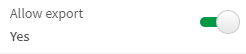
Commentary exporting can be enabled or disabled if desired. To enable or disable commentary exporting please follow these steps:
1\. Edit the sheet and select your Qommentary Insights extension\
2\. Expand *Commentary > General* section in the properties panel\
3\. Click on the *Allow export* switch control to enable or disable commentary export
To export a commentary to PDF, please follow these steps:
1. Click on the  icon

2\. A commentary report will be generated on the fly

icon

2\. A commentary report will be generated on the fly